

HIPAA Compliant Collaboration in Modern Therapy Teams
Last Updated on November 26, 2026
HIPAA compliant Collaboration lets behavioral health providers, multidisciplinary teams, and external specialists coordinate client care safely — using role-based permissions, end-to-end encryption, and compliant documentation channels. Centralizing records inside dedicated practice management software means clinical teams stop relying on insecure emails, fragmented faxes, and manual workarounds that invite both federal penalties and client distrust.
Consider the typical caseload: a client sees an individual therapist, a psychiatrist managing medications, and an occupational specialist. Every clinician needs recent progress updates, treatment goals, and risk assessments. But passing sensitive behavioral records between independent providers exposes protected health information (PHI) the moment someone reaches for a standard email attachment or a consumer messaging app. The liability is real and the exposure is immediate.
Modern clinics need structured workflows that connect providers without exposing sensitive data. Protecting client privacy requires purpose-built software that enforces privacy boundaries at every step of clinical delivery.
Core Principle for Collaborative Care:
Collaboration should never compromise confidentiality. Under federal guidelines, providers must restrict PHI disclosure to the minimum necessary standard while Maintaining strict audit logging for all shared files.
The Hidden Vulnerabilities of Informal Provider Communication: Hipaa Compliant Collaboration Explained
Care coordination most often breaks down during routine handoffs — not dramatic security incidents. A therapist emails an intake assessment to a colleague. A clinic coordinator faxes session notes to an external psychiatrist. A provider texts a quick diagnostic summary to a supervisor. Each of those actions violates Compliance standards unless the medium includes end-to-end encryption, audit logs, and signed business associate agreements.
The HHS HIPAA Privacy Rule requires covered entities to implement administrative, physical, and technical safeguards. Standard email lacks encryption across external servers. Consumer messaging apps store unencrypted attachments directly on mobile devices. Even basic cloud storage folders leave files open to accidental link-sharing. None of these tools were built for clinical PHI.
The consequences aren’t hypothetical. If an unintended party opens an email containing a diagnostic code or Therapy summary, your clinic has an active data breach on its hands. Fines can reach thousands of dollars per violation, and clients who discover their personal history leaked into administrative channels don’t forget it. Unregulated communication channels remain the single largest point of failure for expanding Therapy practices.
How Can Therapists Share Notes Without Violating HIPAA?
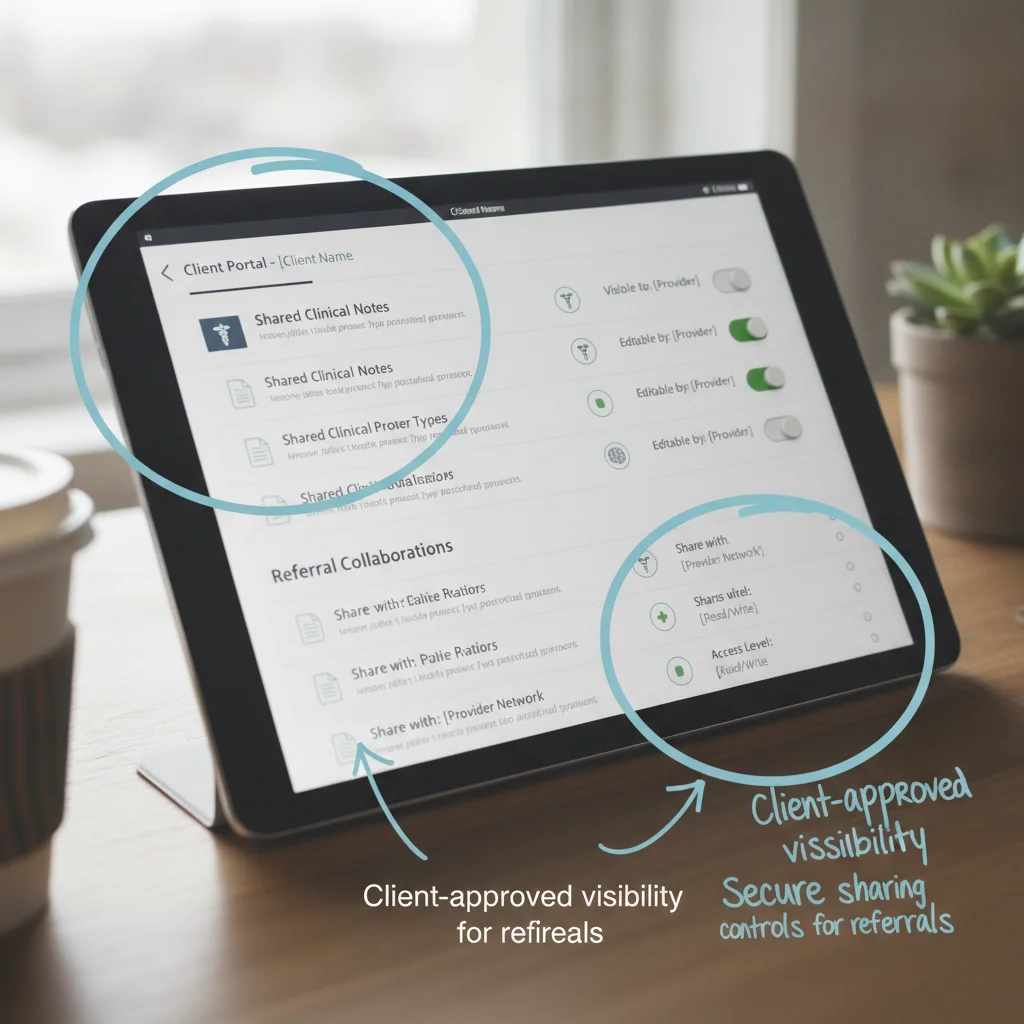
Safe note-sharing comes down to role-based access controls and client-signed disclosure authorizations inside a unified platform. The mistake most practices make is treating clinical documentation as all-or-nothing. Either everyone gets the full chart or nobody does. Modern behavioral health demands something in between: segmented visibility tied to clinical role.
Three structural defenses make that possible:
- Separate psychotherapy notes from standard medical documentation. HIPAA grants heightened legal protections to private psychotherapy notes. Keep those personal process observations isolated from general treatment summaries, medication plans, and billing codes — they’re a different category entirely.
- Define granular role-based permissions. Administrative staff need demographic data and insurance billing details, not clinical narratives. External medical collaborators need diagnostic summaries and medication evaluations, not raw session content. Restrict access so each staff member sees only what their role demands.
- Enforce time-limited access tokens. When consulting an outside expert on a complex case, grant access to specific charts for a defined window rather than distributing static PDF exports that live on someone’s hard drive indefinitely.
Using Hypnotes practice management features, clinicians exchange client documents without downloading vulnerable copies to desktop drives. Granular access controls allow clinical teams to share relevant diagnostic progress while keeping raw session notes private.
A 4-Step Protocol for Secure Inter-Practitioner Communication
Don’t leave Inter-provider communication to individual preference. Train your staff to follow an exact protocol for every cross-provider engagement — no exceptions, no shortcuts.
Step 1: Execute a Written Release of Information (ROI)
Never transmit client records without an active, explicit ROI on file. The consent form must name the specific external clinician, state the exact scope of information to share, and list a concrete expiration date. Store signed copies directly inside the client document profile.
Step 2: Apply the Minimum Necessary Standard
Review the requested file before sending. If a primary care physician requests confirmation of treatment attendance, don’t send comprehensive clinical narratives. Transmit only attendance dates, treatment goals, and current functional scores.
Step 3: Transfer Files Through Encrypted Portals
Banish email attachments and traditional mail. Route documents through a Secure client and provider portal. This ensures data stays encrypted at rest and in transit, requiring multi-factor authentication from both parties before any PHI appears on screen.
Step 4: Maintain System Audit Trails
Every shared note must generate an automated system record. Verify that your platform logs the user ID, timestamp, file identity, and specific action taken for every access event. Audit logs provide indispensable proof of Compliance during regulatory reviews.
Following these steps eliminates administrative guesswork. Systematic data handoffs protect your practice against privacy breaches while speeding up clinical coordination.
Comparing File Transfer Methods in Therapy Practices
Many Therapy clinics juggle multiple communication tools, unaware of how those options hold up under federal scrutiny. The table below shows how common coordination channels compare against dedicated behavioral health software.
| Communication Channel | HIPAA Compliant | Access Controls | Automatic Audit Trail | Operational Risk |
|---|---|---|---|---|
| Standard Email | No | None (Once sent) | No | Critical |
| Paper Fax Machines | Conditional | Physical only | Minimal | Moderate to High |
| Consumer Cloud Storage | Rarely (Requires BAA) | Folder level | Partial | High |
| Hypnotes Unified Platform | Yes (Full BAA) | Granular Role-Based | Yes (Complete) | Low (Protected) |
Patchwork communication systems create serious legal exposure. Consolidating provider coordination into a Secure practice management platform removes transmission errors and centralizes accountability.
How Does Referral Management Protect Behavioral Health Practices?

Referral management protects practices by tracking every incoming and outgoing client transition through an encrypted, auditable pipeline. When primary physicians or psychiatrists send referrals via paper notes or standard email, records get misplaced. The receiving provider often lacks vital diagnostic history, while the referring clinician has no visibility into whether the client was even contacted.
A closed-loop referral system solves this cleanly. Staff collect client data directly through Secure digital intake forms and surveys. Clinical documents, past medication histories, and baseline evaluations map straight to the newly generated client chart — no re-entry, no transcription errors, no missing pages.
This organized handoff also ensures the referring provider receives timely status updates through Secure channels, without exposing clinical narratives to unintended parties. One system holds the whole transition. The medical record stays intact, and intake moves faster.
Independent clinicians and expanding group practices can review available Hypnotes pricing plans to find the right fit for their team size. Structured referral tracking transforms messy clinical handoffs into organized, compliant, and auditable client journeys.
Streamlining Team Collaboration with Built-In Hypnotes Tools
Clinical teamwork demands more than document storage. Clinicians balance scheduling, appointments, documentation, telehealth sessions, and insurance billing every single week. Disjointed tools force practitioners to export, convert, and re-upload files repeatedly — and every unnecessary file transfer is another opportunity for a privacy incident.
Hypnotes integrates clinical coordination directly into daily practice management workflows:
- AI Scribe and AI Assistant: Converting consultation notes into structured clinical documentation is time-consuming work. The AI Scribe drafts progress notes from sessions quickly, so supervisors and collaborators can review treatment trajectories without waiting days for a clinician to find writing time.
- Integrated Telehealth Security: Multi-provider case conferences happen through compliant telehealth channels. External consultants join virtual clinical reviews without downloading unencrypted recordings or sharing screens outside a Secure environment.
- Unified Forms and Surveys: Standardize clinical assessments across your entire team. Send questionnaires directly to clients through the encrypted portal, and their responses automatically update the chart for all authorized care team members.
- Centralized Billing and Superbills: Coordinate billing codes and insurance claims without exposing confidential Therapy observations to outside billing specialists.
Clinicians retain full ownership of their notes. Group practices gain complete visibility over administrative operations. Nobody’s downloading files to a personal desktop just to get work done. Consolidating scheduling, clinical documentation, and billing into one ecosystem preserves security without slowing down your practitioners.
Frequently Asked Questions
What makes Inter-Practitioner communication HIPAA compliant?
HIPAA compliant communication requires end-to-end data encryption, signed Business Associate Agreements, role-based access permissions, and verifiable audit trails for all shared protected health information. Basic consumer email or texting tools lack these technical safeguards and violate federal privacy standards.
Can therapists share session notes with external providers under HIPAA?
Yes, therapists can share treatment notes if the client has signed a compliant release of information and the shared data adheres to the minimum necessary standard. Sharing general treatment summaries, functional goals, and medication responses is standard practice, whereas private psychotherapy process notes require separate, specific authorization.
How does Hypnotes Secure collaborative Therapy records?
Hypnotes protects records through granular permission controls, encrypted document transfers, Secure telehealth channels, and automated audit logs within a unified practice management system. Team members only access files essential to their clinical role — nothing more.
What is the difference between general medical records and psychotherapy notes under HIPAA?
Psychotherapy notes receive extra protection under HIPAA and require explicit client authorization for disclosure, separate from general treatment, payment, or healthcare operations. General medical records — diagnoses, symptoms, medication prescriptions, treatment plans — can be shared for coordinated care under standard releases.
Upgrade Your Practice to Secure Collaboration Today
Delivering high-quality behavioral care requires open teamwork between therapists, psychiatrists, and medical providers. You don’t have to choose between clinical coordination and regulatory Compliance. With the right platform, your team can coordinate care plans, document sessions with an AI Scribe, and track client referrals safely — all from one place.
Hypnotes gives modern behavioral health teams the tools to simplify administration and protect client data. Start your 14-day free trial of Hypnotes today to experience Secure, compliant Collaboration firsthand.